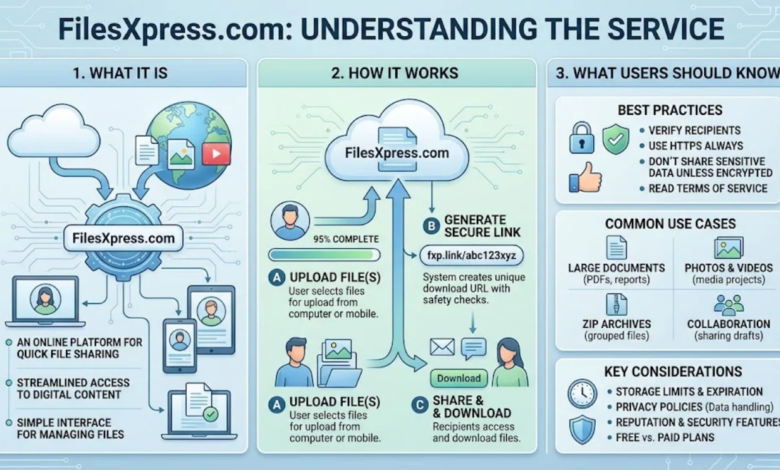
FilesXpress.com is a website associated with online file sharing and digital file storage. The name is relevant to people searching for file-upload services, older download links, and convenient ways to exchange digital documents. Online file-sharing platforms have become important because email attachments often have size limitations, while documents, photographs, spreadsheets, and other digital resources can be difficult to transfer between devices. FilesXpress.com has appeared in online references related to uploading files and sharing download links. However, users should distinguish between the website’s historical purpose, its current availability, and the features that can actually be verified today.
Quick Bio Table
| Website Detail | Information |
|---|---|
| Website Name | FilesXpress.com |
| Website Type | Online file sharing and storage |
| Main Topic | Digital file transfers |
| Primary Purpose | Uploading and sharing files |
| Potential Users | Individuals, professionals, and technology users |
| Common File Categories | Documents, images, spreadsheets, and archives |
| Domain Registration | April 25, 2015, according to third-party domain records |
| Current Status | Domain resolution is reported; full functionality requires verification |
| Main Concern | Accessibility, privacy, and download safety |
What Is FilesXpress.com?
FilesXpress.com is associated with the concept of transferring files online without relying exclusively on email attachments or physical storage devices. File-sharing services generally provide a way to make digital content accessible to another person through a web address or download link. This approach can be useful when colleagues need to exchange documents, customers need to receive digital materials, or technical support teams require files to investigate a problem.
The FilesXpress name has appeared in historical technology-related discussions in which users were directed to upload files and share links with other people. These references help explain the website’s association with online file sharing. Nevertheless, historical references do not prove that every previously available feature remains operational today.
People searching for FilesXpress.com may have different goals. Some may be looking for information about the platform, while others may have discovered an old link in a forum, email, or technical support conversation. Understanding the reason behind the search helps users decide whether they need general information, an accessible download, or a modern alternative.
How Does FilesXpress.com Work?
Online file-sharing platforms typically follow a straightforward process. A user selects a file from a computer or mobile device, uploads it to a service, and receives a link that can be shared with an intended recipient. Depending on the platform, the recipient may be able to view the file in a browser or download a copy.
The convenience of this process comes from separating the file itself from the message used to share it. Instead of attaching a large document to an email, the sender can provide a link. This can simplify communication and make it easier to exchange files across different devices and operating systems.
However, the exact upload process, file-size limits, account requirements, retention periods, and sharing controls available on FilesXpress.com should not be assumed without current verification. Different services offer different capabilities, and a feature common to modern cloud-storage platforms may not be available on an older website.
Why Do People Search for FilesXpress.com?
One reason people search for FilesXpress.com is to identify an unfamiliar website. They may encounter its name in an old message or discover it while looking for a file mentioned in an online discussion. In these situations, the main question is often whether the website still works and whether a particular download can be accessed.
Another reason is the continuing need for simple file-transfer solutions. Students exchange assignments, employees send reports, designers deliver images, and technology enthusiasts share diagnostic documents. These activities explain why online file-sharing services have remained useful even as cloud-storage platforms have become more widespread.
Some visitors may also be researching the site’s history, reliability, or alternatives. For these readers, a useful overview should explain the general purpose of file-sharing websites while clearly separating confirmed information about FilesXpress.com from assumptions about its present-day features.
Can You Still Access FilesXpress.com?
The availability of a domain and the functionality of a website are two different things. Domain-information records currently report that FilesXpress.com resolves and redirects to its www version. The domain record also lists April 25, 2015, as its registration date. These details provide useful technical context, but they do not establish that every page, upload function, or previously shared file is accessible.
A website may resolve successfully while some of its features remain unavailable. Its homepage might load even when older downloads have been removed, or the server may respond while a particular page produces an error. Individual files can also become unavailable because of deletion, expiration, changes in access permissions, or modifications to the service.
If you are looking for a specific file, check the original source of the link and confirm that the address is correct. If the download fails, avoid repeatedly trying unrelated addresses or downloading replacement files from untrusted websites. When possible, contact the person who originally shared the file and request a fresh copy through a trusted channel.
FilesXpress.com Safety and Privacy Considerations
Safety is an important consideration whenever you visit a file-sharing website. A file may contain legitimate information, but it could also include malicious software, misleading content, or a document designed to trick the recipient. The website’s name alone cannot establish whether an individual download is safe.
Before opening a shared file, consider whether you recognize the sender and whether you were expecting the download. Be especially cautious with executable files, unexpected software installers, compressed archives from unknown sources, and documents that ask you to enable macros. Use reputable security software and keep your operating system and browser updated.
Privacy deserves equal attention. Before uploading sensitive documents, determine who can access the file, whether a public link can be forwarded, and how long the content may remain available. Avoid sharing financial records, identification documents, confidential business materials, or personal information through a service whose privacy practices you cannot verify.
An HTTPS connection is helpful because it encrypts information transmitted between the browser and website. However, encryption does not guarantee that a service is trustworthy or that every file hosted on it is harmless. Users should assess the source, destination, and nature of the download rather than relying on a single technical indicator.
Benefits and Limitations of Online File Sharing
The main benefit of online file sharing is convenience. Users can send digital content without needing to meet in person or transfer files using a USB drive. Sharing a link can also simplify collaboration when multiple people need access to the same resource.
Another advantage is flexibility. Web-based services can make it easier to exchange information between computers, tablets, and smartphones. Depending on the platform, users may also benefit from browser-based access, temporary download links, or controls that restrict access to selected recipients.
Nevertheless, file-sharing services have limitations. Upload speeds depend on internet connectivity, large files may take considerable time to transfer, and some services impose storage limits. Links can expire, files can be removed, and recipients may have difficulty accessing content if permissions change.
For these reasons, anyone relying on a file-sharing platform for important work should maintain appropriate backups and choose a service that clearly explains its storage, access, and privacy policies. Users should not assume that a shared link will remain available indefinitely.
Alternatives to FilesXpress.com
If FilesXpress.com does not meet your needs, several established services offer alternative approaches to sharing files. Google Drive provides cloud storage and document-sharing features, while Microsoft OneDrive integrates file storage with Microsoft productivity tools. Dropbox is another option for synchronizing files and sharing content with other people.
For users who need to send files without maintaining a traditional shared-storage folder, dedicated file-transfer services may be more appropriate. The right choice depends on file size, recipient access, privacy requirements, collaboration needs, and whether a free plan is sufficient.
Before choosing an alternative, compare its current storage limits, link-expiration settings, access controls, pricing, and data-handling policies. Businesses dealing with confidential information should pay particular attention to administrative controls and organizational security requirements.
Choosing a recognized service does not eliminate every risk, but it can make it easier to find documentation, understand available features, and obtain support when something goes wrong.
Who Should Consider Using a File-Sharing Website?
File-sharing websites can be useful for students, freelancers, small businesses, office teams, and individuals who regularly exchange digital materials. A student may need to send a presentation to a classmate, while a designer may need to deliver a collection of images to a client. In both cases, an online transfer can be more convenient than a physical handoff.
Businesses may use file-sharing tools to distribute reports, project documents, and approved resources between team members. However, organizations should select platforms that meet their requirements for permissions, data retention, compliance, and account management. A general-purpose file-sharing website may not be suitable for every professional task.
For casual users, simplicity and accessibility may be the most important considerations. For professional users, security, reliability, collaboration tools, and recovery options may matter more. The best service is the one that meets the actual requirements of the task rather than simply offering the shortest upload process.
Frequently Asked Questions About FilesXpress.com
What is FilesXpress.com used for?
FilesXpress.com is associated with online file sharing and storage. Historical references connect the name with uploading files and sharing download links. Its currently available features should be verified independently.
Is FilesXpress.com still working?
Domain-information records report that the domain resolves and redirects to its www version. This does not confirm that all website features or old downloads are working.
Is FilesXpress.com safe?
Its safety cannot be established from the domain name alone. Check the address, consider the source of the file, avoid suspicious downloads, and do not upload confidential information unless the service’s security and privacy practices are clear.
Can I recover an old FilesXpress download?
Recovery depends on whether the original file still exists and whether the relevant link remains accessible. You may need to contact the original sender or request another copy from a trusted source.
What are the alternatives to FilesXpress.com?
Google Drive, Microsoft OneDrive, Dropbox, and dedicated file-transfer services are potential alternatives. Compare their current features, access controls, storage limits, and privacy policies before choosing one.
Final Thoughts
FilesXpress.com is a relevant topic for anyone researching online file sharing, older download links, and the changing ways people exchange digital information. Its historical association with file uploads and downloadable links helps explain why users may still search for the domain. However, current domain resolution should not be confused with verified service availability, and old links should always be approached with care. By checking the source of a file, protecting personal information, and considering reliable alternatives when necessary, users can make more informed decisions about digital transfers. For readers interested in practical technology guides, website explanations, and online tools, starinsiderhub aims to provide useful information that helps them navigate the digital world with greater confidence.
Read More: WhatsApp Web Made Simple: Chat, Work, and Stay Connected