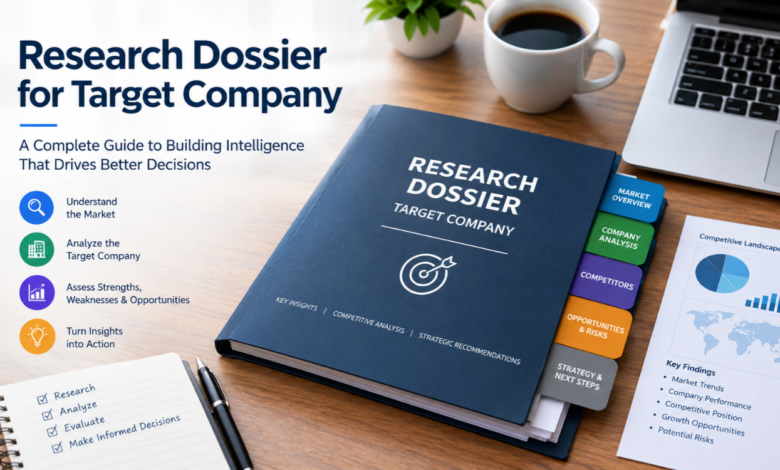
Research Dossier for Target Company: A Complete Guide to Building Intelligence That Drives Better Decisions

Every serious business decision, whether it is an acquisition, an investment, a partnership, or a competitive move, Research Dossier for Target Company begins with information. But raw information is not intelligence. A folder full of press releases, social media posts, and old news articles does not tell you whether a company is healthy, risky, or worth your time. What transforms scattered data into actionable insight is a structured research dossier. A research dossier for a target company is a consolidated, verified, and contextualized document that answers the questions decision makers actually need answered before they commit resources. This article explains what a research dossier is, why it matters, what it should contain, how to build one step by step, and the mistakes that most commonly undermine its value.
Quick Bio Table
| Field | Details |
|---|---|
| Document Type | Business intelligence research dossier |
| Primary Users | Investors, M&A teams, sales strategists, executives |
| Core Purpose | Consolidate verified facts about a target company |
| Key Sections | Identity, leadership, financials, competition, risks, sources |
| Typical Length | 10 to 30 pages depending on purpose |
| Update Frequency | Quarterly or before any major decision |
| Critical Principle | Separate verified facts from estimates and opinions |
What a Research Dossier Actually Is
A research dossier is not a sales brochure and it is not a data dump. Research Dossier for Target Company It is a decision support document. Its job is to present a coherent picture of a target company so that a reader who has never encountered that company can understand its business, its leadership, its financial position, its competitive standing, and its exposure to risk within a short reading session. The dossier should be balanced. That means it must include negative information alongside positive information, and it must clearly label anything that is estimated, rumored, or unverified. Research Dossier for Target Company The discipline of labeling is what separates a professional dossier from a collection of bookmarked web pages.
Why the Dossier Matters More Than Ever
Information about companies is abundant but unreliable. Marketing pages exaggerate. Old articles carry outdated executive names. Social media mixes genuine customer complaints with coordinated criticism. A well built dossier cuts through this noise by triangulating sources and recording where each claim came from. For investors, Research Dossier for Target Company the dossier reduces the risk of backing a company whose revenue growth is impressive but whose cost structure is deteriorating. For acquisition teams, it surfaces integration risks early, before legal fees and negotiation costs accumulate. Research Dossier for Target Company For sales and business development teams, it provides the specific, current context needed to open a credible conversation rather than sending a generic pitch that decision makers ignore.
Core Components of a Professional Dossier
The first component is company identity. Establish the exact legal entity, Research Dossier for Target Company its registration details, its headquarters, and its corporate family structure. Confusion between a parent company and its subsidiary is one of the most common errors in early stage research, and it can distort every financial figure that follows.
The second component is the business model. Explain in plain language how the company makes money. What does it sell, who buys it, and what problem does it solve. Is revenue recurring through subscriptions, Research Dossier for Target Company one time through product sales, or blended through advertising and services. Avoid repeating the company’s own marketing language. Describe the mechanism.
The third component is leadership and ownership. Identify founders, executives, board members, and major shareholders. Verify that the information is current by checking official pages, regulatory filings, and recent announcements rather than relying on older profiles. Note any recent departures, because executive turnover is often an early signal of internal stress.
The fourth component is financial information with context. For public companies, gather revenue, operating income, net income, cash flow, debt levels, and margins across multiple periods. Trends matter more than single numbers. Research Dossier for Target Company A company growing revenue by twenty percent while costs grow by thirty five percent tells a very different story than the headline growth figure suggests. For private companies, rely on estimates from industry databases and clearly mark them as estimates. Never present an estimate as a confirmed fact.
The fifth component is the competitive landscape. Compare the target against direct competitors and indirect alternatives. A comparison table covering offerings, target customers, pricing, strengths, and weaknesses quickly reveals where the target is exposed. Competitors should be selected based on genuine market overlap, and the reason for including each one should be stated.
The sixth component is risk and negative information. This includes legal disputes, regulatory actions, product recalls, cybersecurity incidents, customer complaints, supply chain vulnerabilities, and executive departures. The goal is not to condemn the company but to give the reader a complete picture. Distinguish between documented facts and speculation, and assess the materiality of each risk rather than listing every minor complaint as though it were existential.
The seventh component is source documentation. Every important claim should be traceable. Record the source, the publication date, the access date, and whether the information was independently verified. This practice protects the researcher, supports later updates, and gives the reader confidence in the dossier’s reliability.
Building the Dossier Step by Step
Begin with scope definition. Clarify why the dossier is being prepared and who will read it. An investor needs different depth than a sales team. A clear purpose prevents wasted effort and keeps the document focused.
Next, conduct broad discovery. Collect annual reports, regulatory filings, official company pages, industry reports, news coverage, and customer reviews. At this stage, gather widely without judging quality, because early judgment causes researchers to miss important context.
Then move to verification. Cross check every significant claim against at least one independent source. When sources conflict, record the conflict rather than silently choosing one version. Conflicts are themselves useful intelligence.
After verification, structure the findings into the components described above. Write in plain language, use tables for comparisons, and label estimates clearly. Keep the executive summary short and place it at the front so busy readers can absorb the key conclusions quickly.
Finally, establish an update schedule. Companies change, and a dossier that is six months old can mislead. Quarterly reviews, or reviews triggered by major events such as funding rounds, leadership changes, or acquisitions, keep the document trustworthy.
Common Mistakes to Avoid
The most common mistake is copying marketing material and presenting it as analysis. The second is mixing parent and subsidiary data, which distorts financial comparisons. The third is ignoring negative information, which creates a false sense of security and damages credibility when problems later surface. The fourth is failing to date information, which makes it impossible to judge relevance. The fifth is treating management forecasts as facts. Each of these mistakes is avoidable with discipline and a clear sourcing standard.
Conclusion
A research dossier for a target company is ultimately an exercise in disciplined thinking. It requires curiosity during discovery, skepticism during verification, and clarity during writing. Organizations that build this capability make faster and better informed decisions, avoid costly surprises, and negotiate from a position of knowledge rather than assumption. Whether the purpose is investment, acquisition, partnership, or competitive positioning, the dossier remains one of the most reliable tools available for turning information into advantage. Readers who want more practical business research frameworks and intelligence guides can explore the resources published at starinsiderhub, where detailed articles on research methodology and decision support continue to be added.
Read More: BenzyNews Com: What It Is, What It Covers, and How to Use It Wisely