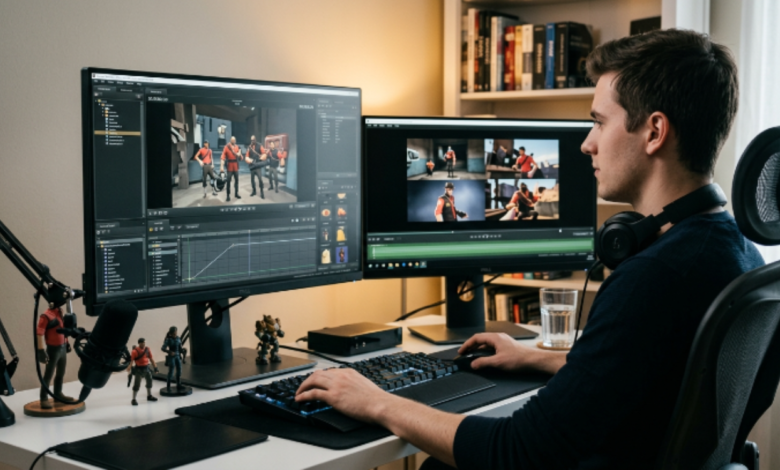
Source Filmmaker, commonly known as SFM, is a powerful animation and filmmaking application that allows creators to build scenes, animate characters, create cinematic sequences, and produce machinima. However, when creators want to use custom models instead of the assets already available in SFM, they often encounter an important technical process known as SFM compile. SFM compilation involves converting prepared 3D assets into formats that Source Filmmaker can recognize and use correctly.
Quick Bio Table
| Topic | Information |
|---|---|
| Full Name | Source Filmmaker |
| Common Abbreviation | SFM |
| Main Technology | Source Engine |
| Main Compile Purpose | Preparing custom assets for SFM |
| Common Source Files | SMD, DMX, QC |
| Compiled Model Files | MDL, VVD, VTX, PHY |
| Common Compiler | StudioMDL |
| Popular Compilation Tool | Crowbar |
| Modeling Software | Blender, Maya, 3ds Max |
| Main Users | Animators, filmmakers, modders, 3D artists |
What Is SFM Compile?
SFM compile refers to the process of converting a prepared 3D model and its associated information into files that the Source engine can understand. A model created in Blender, Maya, or another 3D application normally exists in a format intended for editing. Source Filmmaker requires its assets to follow the Source engine’s specific structure and file formats.
A typical workflow can be understood as 3D model to SMD or DMX, then QC instructions, followed by StudioMDL or another compiler, and finally a compiled model that can be used inside SFM. Depending on the project, the process can include geometry, skeletons, animations, materials, and physics information.
This is why simply putting a Blender project or another ordinary 3D file into an SFM folder usually does not make the model available. The model needs to go through the appropriate preparation and compilation process first.
Why Is Compilation Necessary in Source Filmmaker?
Source Filmmaker uses an asset pipeline designed around Valve’s Source engine. Unlike many modern 3D applications, it does not simply load every common 3D project format directly.
Compilation converts information from the original modeling program into data that the Source engine can interpret. It also allows creators to define important properties of the model, including its name, mesh, materials, animations, skeleton, and physics settings.
For example, someone creating a custom character may need to compile the character mesh, skeleton, animations, and physics information separately or together according to the requirements of the project.
Understanding this workflow is particularly useful when a model does not appear in SFM, has missing textures, does not animate correctly, or generates errors during compilation.
Important Files Used in SFM Compile
Several file types are commonly encountered when compiling models for Source Filmmaker.
SMD files can contain model geometry, skeletal information, or animation data depending on how they are created. DMX files are another format used within Source-related workflows and can store different types of model and animation information.
The QC file is one of the most important parts of the process. It is a text-based instruction file that tells the compiler how the model should be assembled.
After compilation, the process can generate several Source model files. The MDL file contains important model information, while VVD files contain vertex-related information and VTX files contain optimized rendering data. A PHY file can be used when the model has physics or collision information.
These files generally work together. Therefore, deleting or moving individual compiled files without understanding their purpose can cause the model to stop working correctly.
What Is a QC File?
A QC file can be considered the instruction sheet for an SFM model compile. It contains commands that tell the compiler what source files to use and how the final model should be constructed.
A basic QC file can specify the output model name, body mesh, material directory, and animation sequence. A simple example might look like this:
$modelname "custom/example.mdl"
$body "Body" "example.smd"
$cdmaterials "models/custom/"
$sequence "idle" "idle.smd" fps 30
The exact commands required depend on the asset. A simple prop may only require a few commands, while a detailed character can require considerably more information.
Characters with multiple animations, facial controls, body groups, physics models, and complex skeletons may require a much more advanced QC configuration.
Because the compiler follows the instructions inside the QC file, even a small spelling mistake or incorrect file path can cause the compilation to fail.
StudioMDL and Crowbar
When researching SFM compile, two important names frequently appear: StudioMDL and Crowbar.
StudioMDL is the Source model compilation utility associated with the Source engine. It processes QC instructions and creates the compiled model files required by the engine.
Crowbar provides a graphical interface that can simplify several Source-engine development tasks, including model compilation. Instead of relying entirely on command-line instructions, users can select files and configure compilation through a visual interface.
For beginners, a graphical tool can make the process easier to understand. More experienced users may prefer direct compiler commands because they provide greater control and can be useful for repetitive workflows.
Regardless of which approach is used, the important part is understanding what the compiler is doing and how the resulting files relate to the original model.
Preparing a Model Before Compilation
Successful SFM compilation starts before the compiler is opened. The original model should first be properly prepared in the chosen 3D application.
For a character, preparation can include creating clean geometry, UV mapping, assigning materials, creating a compatible skeleton, and preparing animations. Props can have fewer requirements, but they still need properly prepared geometry and materials.
Blender is widely used by creators working with Source-related assets, while Maya and 3ds Max can also be used depending on the creator’s workflow.
Before exporting, creators should check the model’s scale, transforms, bone structure, weight painting, material assignments, and filenames. Problems at this stage can later appear as compilation errors or unusual behavior inside SFM.
Understanding SFM Materials and Textures
Model compilation and texture preparation are connected but separate parts of the workflow. A model can compile successfully while still displaying incorrect or missing textures.
Source materials commonly use VMT material files and VTF texture files. The material configuration tells the Source engine how the material should behave and which texture information it should use.
If the material path is incorrect, SFM may display missing-material visuals even though the model itself compiled without an error.
This distinction is important during troubleshooting. If the model appears correctly but the textures are missing, repeatedly recompiling the model may not fix the problem. Instead, the material files, texture files, and paths should be checked.
How to Compile a Model for SFM
The first step is to prepare the model in Blender, Maya, or another compatible application. Make sure the geometry, UVs, skeleton, animations, and materials are ready.
Next, export the required data in a Source-compatible format such as SMD or DMX. The exact export procedure depends on the modeling software and exporter.
After exporting, create the QC file. Specify the output model name, source mesh, material directory, animations, and other necessary settings.
The next step is to use StudioMDL or a suitable graphical compilation tool. Select the appropriate Source Filmmaker environment and provide the QC file.
When compilation begins, examine the compiler output carefully. If there are errors, identify and correct the underlying problem before attempting the compilation again.
After successful compilation, the resulting model files need to be placed within the appropriate SFM content structure. The directory structure should correspond with the paths defined in the QC file.
Finally, launch Source Filmmaker and search for the model. Test its appearance, materials, skeleton, animations, and physics behavior.
Common SFM Compile Errors
One common compilation problem is a missing source file. If the QC file references an SMD or DMX file that cannot be found, the compiler cannot complete the model.
Incorrect material paths are another frequent problem. A model may compile successfully but show missing textures because the material or texture files are stored in the wrong location.
Character models can also experience skeleton and animation problems. Incorrect bone structures, weighting problems, or improperly exported animations may result in strange poses or unusable animations.
Another issue can occur when the compiler is configured for the wrong environment or installation directory. In this situation, the files may be generated in an unexpected location or the compiler may fail to locate required resources.
Reading the compilation output is one of the most effective troubleshooting methods. Instead of repeatedly trying to compile the same project, examine the error message and determine which file, path, command, or configuration is causing the problem.
How to Fix a Model That Does Not Appear
If a compiled model does not appear in SFM, begin by checking whether the compilation actually generated the expected files.
Next, verify the model’s output path. The location defined in the QC file should correspond with the location where the compiled model is expected to be accessed.
If the model appears but has missing textures, inspect the material directory and verify the VMT and VTF files. Make sure the material references correspond with the actual file locations.
If the model appears but is distorted, incorrectly positioned, or impossible to pose properly, examine its skeleton and weight information. Character animations should also be checked if movement is not working as expected.
It is often easier to troubleshoot a simple model first. Once a basic prop successfully compiles and appears inside SFM, more complicated characters and animated assets can be tested.
SFM Compile Best Practices
Keeping project files organized is one of the easiest ways to reduce compilation problems. Store source models, SMD or DMX files, QC files, textures, materials, and compiled files in clearly structured directories.
Use consistent names for files and folders. Avoid unnecessary changes to paths once a project is working.
It is also useful to keep backup versions of working QC files. If a new modification causes a compilation problem, an earlier working version can help identify what changed.
Another good practice is to compile frequently. Instead of adding dozens of features and testing everything at once, compile a basic model first and then gradually add animations, body groups, physics, and other features.
Finally, always pay attention to compiler messages. Warnings and errors can provide useful clues about problems that may not be obvious inside the 3D software.
SFM Compile vs Importing a Normal 3D Model
A common misunderstanding among beginners is that Source Filmmaker should work like a modern 3D application where an FBX, OBJ, or Blender project can simply be imported and immediately animated.
SFM uses a different asset pipeline. A custom model normally needs to be prepared, exported, described through QC instructions, compiled, placed within the correct content structure, and then tested inside the application.
Once this workflow is understood, SFM compilation becomes much easier. Each stage has a specific purpose. The modeling application creates the asset, the exporter prepares Source-compatible data, the QC file tells the compiler how to assemble the asset, and the compiler creates the files required by the Source engine.
Tips for Beginners Learning SFM Compile
Beginners should avoid starting with an extremely complicated character. A basic prop can be a much better first project because it introduces the fundamental workflow without requiring a complex skeleton or animation system.
It is also important to learn the purpose of each file rather than memorizing commands without understanding them. Knowing what an SMD, DMX, QC, MDL, VMT, and VTF file does makes troubleshooting much easier.
When something goes wrong, change one thing at a time. This makes it easier to determine whether a particular modification solved the problem.
With practice, creators can move from simple props to custom characters, animated models, weapons, creatures, and more advanced Source Filmmaker assets.
Final Thoughts on SFM Compile
Understanding SFM compile is an important step for anyone who wants to create and use custom models in Source Filmmaker. Although the process can initially seem complicated because it involves several file formats, directories, QC commands, materials, and compiler tools, the workflow becomes much easier once each component is understood. Proper model preparation, accurate QC instructions, organized files, correct material paths, and careful troubleshooting are the foundations of successful SFM compilation. Readers interested in Source Filmmaker, animation, 3D software, and other digital tools can find more related guides and useful technology content on starinsiderhub.
Read More: YouTube to MP4: YouTube Downloader, Shorts, Premium, TV Login and More