
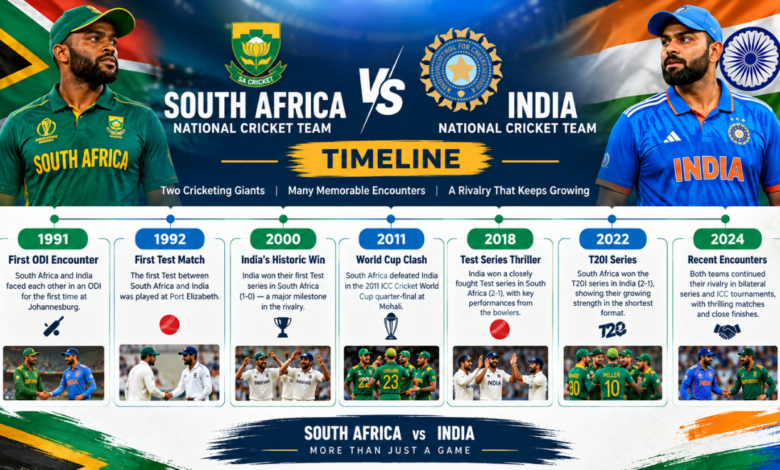
The South Africa national cricket team vs India national cricket team timeline is a fascinating story of changing eras, legendary players, dramatic Test matches, memorable World Cup encounters and the evolution of international cricket. The rivalry officially began in 1991, when South Africa returned to international cricket after a long period of sporting isolation and played its first official ODI against India in Kolkata. Since then, the two nations have competed across Tests, ODIs and T20Is, producing some of the most memorable matches in modern cricket.
| Quick Bio | South Africa National Cricket Team | India National Cricket Team |
|---|---|---|
| Common name | Proteas | Men in Blue |
| International rivalry began | 1991 | 1991 |
| First official meeting | ODI, November 1991 | ODI, November 1991 |
| Test rivalry began | 1992 | 1992 |
| T20I rivalry began | 2006 | 2006 |
| Major strengths | Pace bowling, athletic fielding, powerful batting | Batting depth, spin, pace bowling and tactical variety |
| Major rivalry formats | Tests, ODIs and T20Is | Tests, ODIs and T20Is |
1991: The Beginning of the Rivalry
The modern India-South Africa cricket relationship began on 10 November 1991. South Africa had been excluded from official international cricket since 1970 because of the country’s apartheid policies. Its readmission represented a major moment in sporting history, and India became the opponent for South Africa’s first official international match after its return.
The three-match ODI series in India was therefore much more than an ordinary cricket contest. It represented South Africa’s return to international cricket and introduced a new generation of South African players to the global stage. India won the series 2-1, but South Africa’s victory in the third ODI demonstrated immediately that the returning team could compete at international level.
The series also featured several important names. Kepler Wessels was a leading South African batsman, while Allan Donald quickly became known for his pace bowling. For India, Sachin Tendulkar was already emerging as one of the country’s most important young players.
1992: The First Test Series
The next major stage of the rivalry arrived in 1992, when India toured South Africa for a Test series. The first Test between the nations was played in Durban in November 1992. This series established the rivalry in the longest format and presented Indian batsmen with the unfamiliar challenge of South African pace and bounce.
South Africa eventually won the four-Test series 1-0, with three matches ending in draws. The series was particularly significant because it helped establish South Africa as a competitive Test nation after its return to international cricket.
The 1992 Test series also became historically important for another reason. Television technology and the third-umpire system were used in international cricket during this period, helping establish a major technological development that would later become a normal part of the sport.
1993–1999: The Rivalry Grows
During the 1990s, India and South Africa became regular opponents in international cricket. Their matches were played in different countries and at neutral venues, particularly during an era when triangular and multinational ODI tournaments were extremely common.
South Africa’s strong pace attack often created problems for India outside the subcontinent, while India’s batting strength made matches in Indian conditions highly competitive. Players such as Allan Donald, Shaun Pollock, Gary Kirsten and Daryll Cullinan became important figures for South Africa, while India developed a generation featuring Sachin Tendulkar, Rahul Dravid, Sourav Ganguly and Anil Kumble.
The Test record from the 1990s also shows the competitiveness of the rivalry. South Africa won series in 1992-93 and 1996-97, while India achieved important success when South Africa toured India. By the end of the decade, the two teams had developed a genuine international rivalry rather than simply being occasional opponents.
2000–2009: A New Generation Takes Over
The beginning of the 21st century brought several historic individual performances and closely fought series. India became increasingly confident in overseas cricket, while South Africa remained one of the world’s most respected teams.
Sachin Tendulkar was particularly influential in the rivalry. One of the most memorable moments came in February 2010, when Tendulkar scored an unbeaten 200 in Gwalior against South Africa. It became the first double-century in men’s ODI cricket and remains one of the defining performances in India-South Africa history.
The decade also produced outstanding South African players. Jacques Kallis became one of the most complete all-rounders in cricket history, while Graeme Smith, Shaun Pollock, Mark Boucher and later AB de Villiers played major roles. India’s team was similarly strengthened by Rahul Dravid, Virender Sehwag, VVS Laxman, MS Dhoni and other influential players.
2007: The First T20 World Cup Meeting
T20 cricket added a new dimension to the rivalry. India and South Africa met in the inaugural ICC Men’s T20 World Cup in 2007.
India won the match by 37 runs in Durban. The result was particularly important because it affected South Africa’s qualification prospects for the semi-finals. India eventually went on to win the inaugural T20 World Cup, establishing an early connection between the two teams and major T20 tournaments.
T20 cricket subsequently became one of the most competitive areas of the India-South Africa rivalry. The emergence of the Indian Premier League also increased the number of South African and Indian players familiar with each other’s skills and playing styles.
2010–2015: Memorable Battles Across Formats
The 2010s saw the rivalry become increasingly important in all three formats. India hosted South Africa for Test, ODI and limited-overs contests, while Indian teams continued to tour South Africa.
The period featured some extraordinary individual performances. India’s Virat Kohli developed into a particularly important player in South Africa, while South Africa produced stars such as AB de Villiers, Hashim Amla, Dale Steyn and Faf du Plessis.
The 2013-14 tour of South Africa was especially notable in Test cricket. India faced a powerful South African side led by Graeme Smith, while the South African batting lineup included Amla and de Villiers. The Johannesburg Test produced a dramatic contest, and the series demonstrated the difficulty of winning in South African conditions.
2016–2019: India Becomes Increasingly Competitive Overseas
India’s progress in overseas Test cricket became more visible during the second half of the decade. The arrival of a strong pace-bowling group, including Jasprit Bumrah, Mohammed Shami and others, changed India’s approach to conditions traditionally associated with South African fast bowlers.
The 2017-18 Test series in South Africa was another important chapter. India lost the series 2-1, but won the Johannesburg Test. In the accompanying ODI series, India produced a dominant performance and won 5-1.
The rivalry was no longer simply a story of South African dominance outside India. India had developed a pace attack capable of competing on fast pitches, while its batting lineup had gained considerable overseas experience.
2021–2022: India Wins a Test Series in South Africa
The 2021-22 Test tour became one of the most significant chapters in the timeline. India won the first Test at Centurion, and the result represented an important overseas achievement.
South Africa responded in Johannesburg, but India won the decisive third Test in Cape Town. India therefore won the three-match series 2-1.
The series featured Virat Kohli as India’s Test captain and Dean Elgar leading South Africa. Jasprit Bumrah, Mohammed Shami, Kagiso Rabada and other leading bowlers played important roles.
The result showed how dramatically the competitive balance had changed compared with the early years of the rivalry. India’s fast-bowling resources had become a major weapon in South African conditions.
2023–2024: World Cup Drama and the T20 Era
India and South Africa continued to meet regularly in bilateral cricket and ICC competitions. One of the most important recent encounters occurred during the 2024 ICC Men’s T20 World Cup final in Barbados.
Both teams entered the final unbeaten. India scored 176/7, with Virat Kohli making 76, before South Africa mounted a serious chase. India eventually won by seven runs, securing the T20 World Cup title. The match was one of the closest major finals between the teams and added another historic chapter to the rivalry.
The 2024 final also demonstrated how competitive the two teams had become in T20 cricket. South Africa’s batting threatened to take the match away from India, while India’s bowlers produced crucial moments during the closing stages.
2025: South Africa Tours India
The rivalry continued with a major multi-format tour in 2025. The Board of Control for Cricket in India scheduled South Africa for two Tests, three ODIs and five T20Is. The Test series began on 14 November, followed by the ODI series from 30 November and the T20I series from 9 December.
The two-match Test series was followed by white-ball cricket, giving fans another extended period of India-South Africa competition. The ODI matches were scheduled for Ranchi, Raipur and Visakhapatnam, while the five T20Is were scheduled across Cuttack, New Chandigarh, Dharamsala, Lucknow and Ahmedabad.
Statistically, the long-term rivalry remained closely watched. Through the end of 2025, the men’s Test record stood at 46 matches, with South Africa winning 20, India winning 16 and 10 ending in draws. In ODIs, South Africa had 52 wins to India’s 42 from 97 matches, with three no-results.
2026: Another T20 World Cup Chapter
The India-South Africa rivalry reached another major ICC stage at the 2026 Men’s T20 World Cup. The teams were placed in the same Super Eight group, meaning they met again after the memorable 2024 final. The ICC described the match as a rematch of the previous T20 World Cup title decider.
South Africa won the 2026 Super Eight match in Ahmedabad by 76 runs. South Africa recovered from 20/3 to score 187/7, with David Miller making 63, before India’s innings ended at 111. Marco Jansen and Keshav Maharaj shared seven wickets. The result ended India’s 12-match unbeaten run in Men’s T20 World Cup matches.
This match added an interesting reversal to the recent timeline. India had won the 2024 T20 World Cup final against South Africa, while South Africa responded with a convincing victory when the teams met again in the 2026 tournament.
India vs South Africa: A Rivalry Across Three Formats
One of the defining features of the India-South Africa timeline is that the rivalry has never belonged exclusively to one format.
In Test cricket, South Africa’s pace-friendly home conditions have historically made the country a difficult destination for India. Over time, however, India’s own fast bowlers have become increasingly effective in those conditions.
In ODI cricket, South Africa established a strong record during the 1990s and 2000s, but India became increasingly competitive in the 2010s and 2020s. The two teams have also produced memorable World Cup encounters, making their ODI rivalry particularly recognizable.
T20 cricket has added another layer. The first T20I meeting came in 2006, and the teams have subsequently faced each other in bilateral series and World Cups. The 2007 T20 World Cup, 2024 T20 World Cup final and 2026 Super Eight encounter are particularly important milestones.
Conclusion
The South Africa national cricket team vs India national cricket team timeline stretches from South Africa’s historic return to international cricket in 1991 to major World Cup encounters in the 2020s. What began with a three-match ODI series became a three-format rivalry featuring some of cricket’s greatest players, including Sachin Tendulkar, Jacques Kallis, AB de Villiers, Virat Kohli, Dale Steyn, Jasprit Bumrah and many others. The rivalry has repeatedly changed character as new generations have emerged, making every decade different from the one before it. From the historic 1991 return and the first Test series in 1992 to India’s 2024 T20 World Cup triumph and South Africa’s 2026 response, the story continues to develop. For readers following major cricket rivalries, this complete timeline provides useful historical context, and starinsiderhub will continue bringing readers informative sports stories and cricket-focused content.
Read More: Juwai Morning Teer Result Arcarrierpoint: Latest Results, Timings and How to Check
