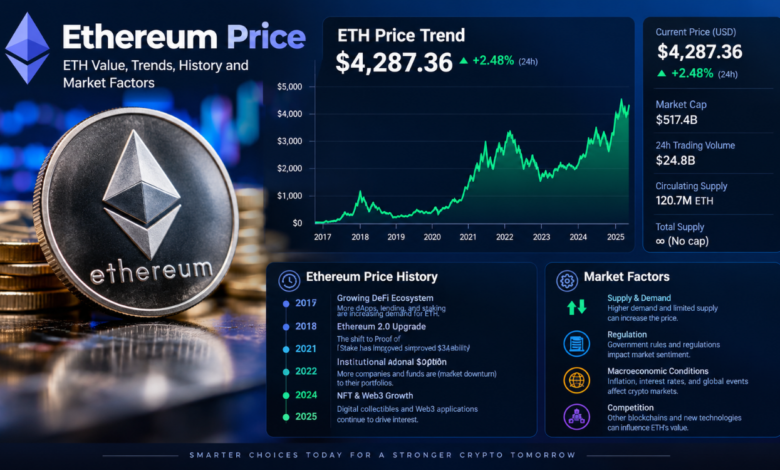
Ethereum remains one of the most closely watched cryptocurrencies in the digital-asset market. The term ethereum price is commonly searched by investors, traders, businesses, developers, and people who simply want to know how much one ETH is currently worth. Unlike traditional financial markets that operate during specific hours, cryptocurrency markets operate 24 hours a day, seven days a week, meaning Ethereum price can change at any time.
As of October 3, 2026, ETH is trading around the $2,680 area, although the exact price changes continuously throughout the day. Recent market activity has shown ETH trading within a relatively narrow range compared with some of its larger historical moves, highlighting how quickly market conditions can change.
Quick Bio of Ethereum
| About | Details |
|---|---|
| Name | Ethereum |
| Cryptocurrency | Ether (ETH) |
| Network Type | Blockchain |
| Main Use | Smart contracts and decentralized applications |
| Consensus Mechanism | Proof of Stake |
| Launch | 2015 |
| Native Asset | ETH |
| Trading | 24 hours a day, 7 days a week |
| Common Price Pair | ETH/USD |
| Major Topics | Price, staking, ETFs, network activity and supply |
What Is Ethereum?
Ethereum is a decentralized blockchain network designed to support smart contracts and decentralized applications. Although people often use the words Ethereum and ETH interchangeably, they technically refer to different things. Ethereum is the blockchain network, while Ether, represented by the symbol ETH, is its native cryptocurrency.
ETH is used to pay transaction fees on the Ethereum network and has an important role in securing the blockchain through staking. Ethereum moved from proof-of-work to proof-of-stake in September 2022, changing how the network is secured and how new ETH is issued.
The Ethereum network has become an important part of the broader digital economy. Developers use it to create decentralized finance applications, non-fungible tokens, stablecoins, games, digital assets, and other blockchain-based services.
Ethereum Price Today
The Ethereum price changes continuously because ETH is traded on cryptocurrency exchanges across the world. Around October 3, 2026, ETH was trading near the $2,680 level. The precise value can differ between exchanges because each trading platform has its own order book, liquidity conditions, and market participants.
This is why an article discussing ethereum price today should always include a date and preferably a time. A price reported in the morning may be different by the afternoon, while major market events can produce even larger changes within minutes.
The current price should also be viewed in context. Looking at only the latest ETH price does not show whether Ethereum has recently gained or lost value, how far it is from its historical high, or what factors are influencing current market sentiment.
Ethereum Price History
Ethereum has experienced several major market cycles since its launch in 2015. Its price history includes periods of rapid growth, major corrections, extended consolidation, and renewed rallies.
During the major cryptocurrency market expansion of 2021, Ethereum reached prices above $4,000 before entering a prolonged downturn in 2022. ETH subsequently recovered during later market cycles, demonstrating the significant volatility associated with the cryptocurrency.
Historical price movements are useful because they show that Ethereum has never followed a straight upward or downward path. Large gains have often been followed by substantial corrections, while periods of weakness have sometimes been followed by renewed demand.
For anyone researching Ethereum price history, it is therefore useful to examine several timeframes rather than focusing on a single day or month.
Ethereum All-Time High
Ethereum’s previous all-time high is an important reference point when analyzing its current market value. ETH reached a record price of roughly $4,946 in August 2025 according to historical market data.
When Ethereum trades significantly below a previous record, market participants often compare the current value with that peak to determine how far the cryptocurrency has moved from its highest recorded level.
However, an earlier all-time high does not guarantee that Ethereum will return to that level. Cryptocurrency markets are influenced by changing economic conditions, investor demand, regulation, technology, liquidity, and market sentiment.
The all-time high is therefore best viewed as historical information rather than a prediction of where ETH will trade next.
What Influences Ethereum Price?
Several factors can affect the Ethereum price. One of the most important is overall cryptocurrency-market sentiment. When investors become more willing to take risks, demand for digital assets can increase. Conversely, periods of uncertainty can lead to selling pressure.
Institutional participation is another important factor. Investment products that provide exposure to ETH have made it easier for some traditional investors to participate in the Ethereum market.
Ethereum network activity can also influence market conditions. The blockchain is used for transactions, decentralized finance, stablecoins, token transfers, and smart contracts. Changes in network usage can affect transaction fees and ETH burning.
Macroeconomic conditions are also relevant. Interest-rate expectations, monetary policy, inflation concerns, liquidity, and the strength of the U.S. dollar can influence investor appetite for cryptocurrencies.
Ethereum ETFs and ETH Demand
Ethereum exchange-traded funds have become an important subject in discussions about ETH price. These investment products give certain investors a regulated market-based method of gaining exposure to Ethereum without directly holding ETH in a personal cryptocurrency wallet.
ETF inflows can provide an indication of demand for investment products linked to Ethereum, while outflows can indicate reduced demand during particular periods.
Recent market coverage in early October 2026 reported several consecutive days of net outflows from U.S. spot Ether ETFs. Such movements can contribute to short-term market sentiment, although ETF flows alone do not determine the future direction of ETH.
Investors generally examine ETF activity together with trading volume, broader cryptocurrency trends, network activity, and macroeconomic developments.
Ethereum Staking and ETH
Staking is another important part of Ethereum’s ecosystem. Following the transition to proof-of-stake, validators participate in securing the network by staking ETH.
Staking can affect how much ETH is actively available for trading because staked ETH may be held for network participation rather than being immediately sold on an exchange.
The staking system also changed Ethereum’s monetary structure. Instead of relying on miners, Ethereum now relies on validators to help maintain network security.
For people researching Ethereum price, understanding staking is useful because ETH is not simply a speculative asset. It also plays a functional role within the Ethereum blockchain.
ETH Supply and Burning
Ethereum’s supply dynamics are more complex than a simple fixed-supply model.
New ETH is issued through the proof-of-stake system. At the same time, a portion of transaction fees is burned, permanently removing ETH from circulation.
The relationship between ETH issuance and ETH burning can influence whether the overall supply is increasing or decreasing during a particular period.
Network activity can therefore have an indirect effect on Ethereum’s supply. When demand for Ethereum block space increases, transaction fees can rise and the amount of ETH burned can also increase.
This makes Ethereum’s monetary system an important factor to understand when researching long-term ETH market trends.
Ethereum Price Technical Analysis
Technical analysis is commonly used by cryptocurrency traders to study Ethereum price movements. Analysts may examine moving averages, support levels, resistance levels, trading volume, momentum indicators, and price patterns.
Recent technical analysis has identified the area around $2,600 as an important support region, while the $2,700 to $2,750 area has been discussed as an important short-term resistance zone.
These levels should not be treated as guaranteed outcomes. Technical indicators are based on historical market behavior, and unexpected news or changes in investor sentiment can quickly alter the price structure.
Technical analysis can be useful for understanding market scenarios, but it cannot eliminate the uncertainty associated with cryptocurrency markets.
Ethereum Price Prediction
Ethereum price prediction is one of the most popular topics among cryptocurrency searches. Analysts frequently publish forecasts for ETH based on technical indicators, market cycles, network adoption, institutional demand, and macroeconomic conditions.
Some recent market analyses have suggested potential recovery scenarios toward the $2,900 or higher range, while other forecasts have presented more cautious possibilities.
The major difference between these predictions comes from their assumptions. One analyst may expect stronger institutional demand, while another may focus on reduced liquidity or weak market sentiment.
For this reason, an Ethereum price prediction should be treated as an estimate rather than a guaranteed future price. Readers should consider the reasoning behind a forecast rather than relying solely on a single numerical target.
Ethereum Price Compared With Bitcoin
Ethereum and Bitcoin are the two most widely recognized cryptocurrencies, but their purposes are different.
Bitcoin is commonly viewed as a decentralized digital monetary asset, while Ethereum is a programmable blockchain designed to support smart contracts and decentralized applications.
ETH and Bitcoin can move in the same general direction because both are affected by overall cryptocurrency-market sentiment. However, Ethereum has its own network activity, staking system, supply dynamics, applications, and technological developments.
A rise in Bitcoin does not automatically mean Ethereum will rise by the same percentage. Likewise, a decline in Bitcoin does not always result in an identical movement in ETH.
Factors That Could Affect Ethereum Price
Several factors could influence Ethereum price over time. Institutional demand, ETF activity, staking participation, network usage, Ethereum upgrades, Layer 2 adoption, transaction activity, cryptocurrency regulation, and global economic conditions can all affect market expectations.
Competition from other blockchain networks is another consideration. Ethereum continues to have a large developer and application ecosystem, but other networks are also competing for users, developers, liquidity, and transaction activity.
Ethereum’s ability to maintain and expand its role in decentralized finance, stablecoins, tokenization, and other blockchain applications could remain an important long-term consideration.
At the same time, investors should remember that cryptocurrency prices can be highly volatile. Short-term price movements can occur even when the underlying network continues to develop.
Frequently Asked Questions About Ethereum Price
What is the Ethereum price?
Ethereum price refers to the current market value of one Ether, or ETH. The price changes continuously as buyers and sellers trade ETH on cryptocurrency exchanges.
Why does Ethereum price change so often?
ETH price changes because of buying and selling pressure, investor sentiment, cryptocurrency-market trends, institutional activity, ETF flows, network developments, economic conditions, and market news.
What was Ethereum’s all-time high?
Ethereum reached an all-time high of approximately $4,946 in August 2025 according to historical market data. Exact figures can vary slightly between different exchanges and data providers.
Does Ethereum have a fixed maximum supply?
Ethereum does not have the same fixed maximum supply structure associated with Bitcoin. Its supply is influenced by new ETH issuance and the amount of ETH burned through network activity.
Is Ethereum still proof-of-work?
No. Ethereum changed from proof-of-work to proof-of-stake in September 2022. Validators now help secure the network through staking.
Why is Ethereum important?
Ethereum is important because it provides infrastructure for smart contracts and decentralized applications. Its ecosystem supports areas such as decentralized finance, stablecoins, digital assets, gaming, and tokenization.
Final Thoughts on Ethereum Price
The ethereum price is influenced by much more than daily buying and selling. Ethereum’s price history, ETF activity, staking, network usage, supply dynamics, technical market levels, macroeconomic conditions, and investor sentiment all contribute to the way ETH trades. Around October 3, 2026, Ethereum was trading near the $2,680 level, but that figure can change quickly because the cryptocurrency market operates continuously. For readers of starinsiderhub, understanding both the current ETH value and the broader factors behind Ethereum’s market movements provides a more complete picture of this major cryptocurrency. Rather than focusing only on short-term predictions, examining Ethereum’s technology, adoption, supply, historical performance, and market conditions can help readers better understand why its price changes over time.
Read More: FintechZoom.com: A Complete Guide to the Financial News and Markets Platform