True People Search is a people-search service that has attracted attention from internet users looking for information connected with names, phone numbers, addresses, and other identifying details. Unlike an official government records portal, it works as an information-aggregation service, bringing together data from different sources into searchable profiles. This makes the phrase “true people search” relevant to people researching someone, checking their own online presence, or trying to understand how personal information becomes available on the internet.
Quick Bio Table
| Detail | Information |
|---|---|
| Name | True People Search |
| Service Type | People-search and information aggregation |
| Main Purpose | Finding publicly available information about people |
| Common Searches | Name, phone number, address |
| Information That May Appear | Names, addresses, phone numbers, relatives and historical information |
| Primary Market | United States |
| Main User Concern | Privacy and accuracy |
| Removal Option | Privacy and opt-out request process |
| Important Limitation | Information may be incomplete or outdated |
What Is True People Search?
True People Search is an online people-finder service designed to help users locate information associated with individuals. The service can be used to search for people by entering information such as a name, telephone number, or address. Depending on the available records, a search may produce several pieces of information associated with a particular individual.
The important thing to understand is that True People Search is not the same as an official government records database. It is an aggregation service, meaning that information can come from different public or commercially available sources. As a result, the information displayed on a profile can change over time and may not always represent a person’s current circumstances.
For anyone researching the keyword “true people search,” this distinction is essential. A search result can be useful as a starting point, but it should not automatically be treated as a definitive or independently verified record.
How Does True People Search Work?
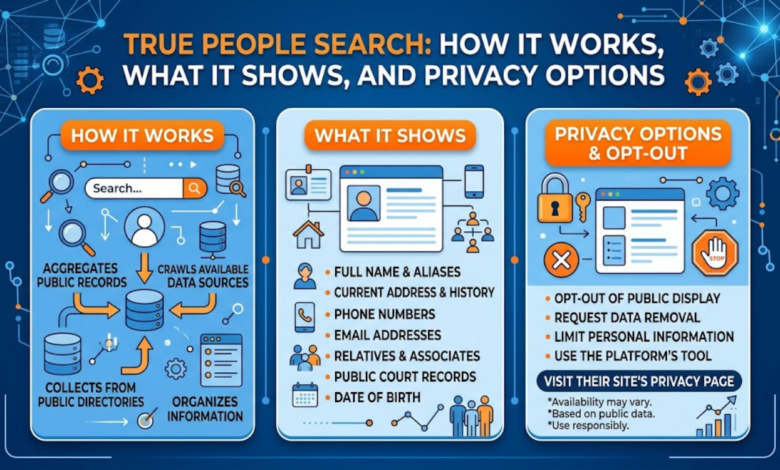
The basic process is relatively straightforward. A user enters identifying information into the search system, and the service attempts to find matching records. The system can connect information from different sources and organize it into a profile or search result.
A person may have more than one result because names can be shared by multiple individuals. Addresses and phone numbers can also change, meaning an older record may remain associated with someone even after they have moved or changed their telephone service.
This is one reason users should carefully examine search results rather than assuming that every piece of information belongs to the person they intended to find. Similar names, outdated addresses, and historical contact details can create confusion.
What Information Can Appear?
The amount of information available can vary considerably between individuals. A typical search may potentially show a person’s name, variations of the name, current or previous addresses, telephone numbers, possible relatives, possible associates, and historical information.
The presence of information depends on what records are available to the service and how those records are matched. Some profiles can therefore be more detailed than others.
Users should also remember that information appearing in an aggregated profile does not necessarily mean that every detail has been recently verified. Historical information can remain relevant to a search even when it no longer reflects someone’s present-day situation.
Is True People Search Free?
True People Search is widely known for offering people-search functionality without requiring users to purchase a conventional subscription simply to perform a basic search. This accessibility is one reason the service has attracted attention among people searching for information online.
However, free access should not be confused with guaranteed accuracy. The value of a people-search service depends on the quality, freshness, and matching of the information it displays.
A user should therefore approach a free search as an information-finding tool rather than as an authoritative background report. When an important decision depends on a particular fact, the relevant official source should be consulted separately.
How Accurate Is True People Search?
Accuracy is one of the most important considerations when using a people-search website. Aggregated databases can contain information that is old, incomplete, duplicated, or incorrectly matched.
Consumer feedback about True People Search includes complaints concerning inaccurate information and privacy-related issues. The Better Business Bureau currently records hundreds of complaints within its three-year reporting period, including complaints involving personal information and removal requests. These complaints represent individual consumer experiences and should not automatically be interpreted as a statistical measurement of the accuracy of every search result.
For that reason, anyone using True People Search should verify important information through authoritative sources. This is particularly relevant when two people have similar names or when an address, phone number, or family association could belong to more than one person.
True People Search and Privacy
Privacy is one of the biggest reasons people search for information about True People Search. People-search services can make personal information easier to discover because they organize information into a searchable format.
Someone who knows only a person’s name may potentially discover additional information connected with that name. Depending on the record, this can include historical addresses, telephone numbers, and possible family or associate connections.
The Better Business Bureau’s profile for True People Search specifically notes that complaints have involved concerns about personal information being disclosed and requests for its removal.
This explains why the subject is relevant not only to people searching for others but also to people who want to understand what information about themselves may be publicly searchable.
Can You Remove Your Information?
True People Search provides a privacy and opt-out process for people seeking removal of information from its service. The exact handling of a request can depend on the circumstances and applicable privacy requirements.
Recent BBB complaint records show examples in which True People Search responded to removal requests by stating that listings had been submitted for removal and asking users to allow several business days for the change to appear online. Other recent complaints show that some privacy requests have involved questions about state residency and applicable privacy laws.
Because privacy procedures can change, people attempting removal should use the current instructions provided by True People Search rather than relying on an old third-party guide. After making a request, it is also sensible to search again later to confirm whether the listing has actually disappeared.
Why Information May Reappear
Removing a profile from one website does not necessarily remove the underlying information from every source on the internet. Public records can continue to exist independently, and other data-aggregation services may collect similar information.
For this reason, online privacy management is often an ongoing process. A person who wants to reduce their public digital footprint may need to check several people-search websites and data brokers rather than relying on a single removal request.
It is also important to distinguish between removing a listing from a search service and changing the original public record. An opt-out generally concerns the way information is displayed or processed by a particular service; it does not necessarily change government records, historical documents, or other independent databases.
What True People Search Should Not Be Used For
Another important limitation concerns the use of people-search information for formal decisions. True People Search states that it is not a consumer-reporting agency under the Fair Credit Reporting Act and that its service should not be used for employment, credit, tenant screening, or related purposes. Recent BBB complaint responses also repeat this limitation.
This matters because a casual online search is very different from an authorized background-screening process. A search result may contain outdated or incorrectly matched information, making it unsuitable as the sole basis for a significant decision.
Tips for Using People-Search Information Responsibly
The safest approach is to treat True People Search results as preliminary information rather than unquestionable facts. Users should check whether the name, location, age range, and other available details actually correspond to the intended person.
Important information should be verified through appropriate authoritative records whenever possible. Users should also avoid assuming that a possible relative or associate shown in a search result necessarily represents a confirmed relationship.
People searching for themselves should take a different approach. They can examine what information appears publicly, document the listings they find, and use available privacy or opt-out procedures when appropriate. Regularly checking online exposure can help people understand how much information about them is easily discoverable.
Final Thoughts on True People Search
True People Search illustrates how easily information from different sources can become searchable through a single online service. It can be useful for locating publicly available information, but users should remember that aggregated information may be incomplete, outdated, or incorrectly associated with an individual. Privacy concerns are also significant, as reflected in recent consumer complaints concerning personal information and removal requests.
For readers researching “true people search,” the key is to understand both sides of the service: its convenience as a people-finding tool and the limitations that come with aggregated personal information. Anyone using the service should verify important facts independently, respect privacy, and avoid using search results for purposes for which the service is not intended. For more informative guides covering online searches, digital services, and internet privacy, readers can continue exploring related topics on starinsiderhub.
Read More: QuikConsole Com: What Is It and What You Should Know